Nutritional Advice
What to feed your tortoise is not a subject which is easy to generalise on, there are many variables! Getting the diet correct needs an understanding of the individual’s nutritional requirements, an understanding of how the environment affects nutritional requirements, as well as a basic understanding of food chemistry, vitamins and minerals. This can be very complicated.
These are not dietary “preferences”- they are dietary essentials.
We cannot stress this enough: learn about the real needs of the species you keep and try to understand the reasons why it has those needs, and then try to find out how best you can meet them.
Variety
In the wild, tortoises tend to be browsers. They wander over quite a wide area and in the process take small quantities of a very wide variety of seasonally available food. Some species are known to consume up to 200 different kinds of plants during the year. The exact combination of plants, and their status, young, fresh and succulent or old and dry, varies seasonally.
The tortoise’s diet changes continually throughout the year, from a fairly high moisture and protein content in spring, to a very dry, and often lower protein content later on in Autumn and winter.
It can be difficult for them to find enough food, and they may need to walk all day, looking for a bite here and a bite there.
By wandering over a wide area, and by consuming such a variety of foods, tortoises should have a well-balanced diet with all the essential mineral trace elements that they require for reproduction and healthy bone development.
Even the best captive diets tend to be very restricted when compared to these natural feeding patterns.
One of the most common mistakes to only feed the favourite food !
Commercial tortoise diets
There are number of ‘complete tortoise diets’ available in pet stores which are in ‘cups’, ‘soft pellets’ and ‘dry pellet’ forms. These are advertised as complete, or almost complete, solutions to all of your tortoise nutrition concerns.
Compared to the wild diet these diets are still generally too high in protein, may have high sugar levels and inadequate amounts of fibre, but can be a useful source of vitamins and minerals.
We do not recommend that you feed your tortoise only on these products but as an addition to a hay, grass and vegetable diet. If you would like to feed these products please speak to our vets in a consultation and they will give you advice on the proportions to feed to balance your tortoise’s diet.
Feeding Grassland Tortoises:
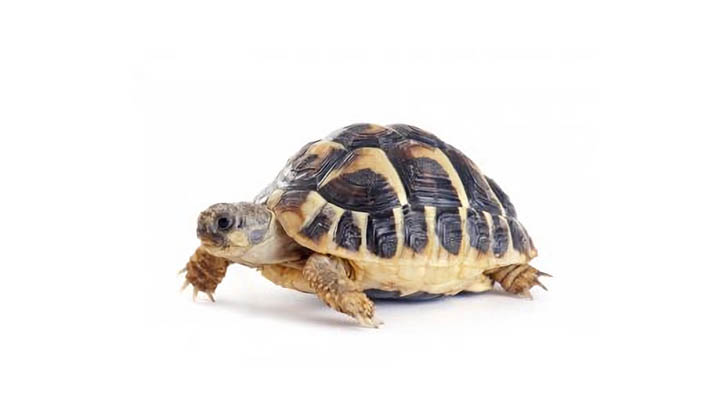
This would include the Mediterranean tortoises (Testudo species), Desert tortoises (Gopherus agassizii), the Russian tortoise (Testudo horsfieldii), Indian Star (Geochelone elegans), large savannah species such as Geochelone sulcata (African spurred tortoise), Geochelone pardalis (Leopard tortoise) and the Aldabra (Aldabrachelys gigantea).
These tortoises are herbivores. Wild tortoises do not eat meat, other than on a very rare and opportunistic basis. It is not a regular part of their diet. Fruit is rarely found on a grassland too !
In captivity their diet should be high in fibre, low protein and calcium rich to ensure good digestive tract function and smooth shell growth.
To provide the high fibre needed we recommend feeding a diet based on a mix of hay andgrasses. This would include timothy hay, natural grass and home grown lawn grass. General ‘meadow hay’ and ‘orchard hay’ mixes are also suitable.
It is best to avoid the use of excessively ‘prickly’ seed heads as they can injure mouths and eyes so to prevent this problem we recommend ‘Timothy Gold’ hay which is ‘second cut’ and tends to have less spiny heads than first cut. There is also a salad mix available of short hay pieces which is ideal.
Ideally this hay based primary diet should be supplemented with grasses and flowers as frequently as possible. Grasses, clover, hibiscus and dandelion can be easily grown in Hong Kong in pots on a balcony or roof. De-spined Opuntia (cactus) pads are sometimes available from the reptile shops in Hong Kong and can also be offered.
Healthy greens can also be offered in smaller quantities, this would include Plantain, Chinese lettuce, Indian lettuce, romaine lettuce, escarole, carrot tops, coriander and parsley. Do not use head lettuces such as iceberg, as these contain very little in the way of vitamins, fiber or minerals.
Commercial ‘Grassland Tortoise’ food can be soaked and added to vegetable mixes.
Restricted greens and vegetables– bok choi, choi sum, spinach, broccoli and other greens may be offered but only in small quantities once to twice per week. If given in excess they can inhibit calcium absorption and can cause health problems.
Calcium and Vitamin/Mineral Supplementation:
Tortoises have quite a high demand for calcium in their diets, especially when growing fast or laying eggs. Such animals may seek out extra calcium to meet these needs. If it is not available, they can rapidly suffer deficiencies.
Tortoises tend to be found in regions where the soils are rich in calcium and other essential trace elements. The wild grasses have a higher calcium level than the supermarket vegetables we buy.
They also have free access to sunlight for basking. Natural sunlight contains UV-B radiation which changes vitamin D into its active form vitamin D3. Vitamin D3 helps the body absorb calcium from the food, so if there is not enough, the calcium will not be absorbed and the bones and shell will not develop properly.
We prefer that the D3 is supplied by natural methods, ie by UVB light, but as the UVB light bulbs are unreliable (unless the output is monitored) we recommend the use of a good quality phosphorus freeCalcium and vitamin D3 supplement. This will vary from once a week to once a day depending on the diet, lighting and the age of the animal.
Some pure calcium should be added to the food every day and a vitamin/mineral supplement should be added once per week.
The use of a cuttlefish bone or calcium block left in the enclosures allows tortoises to regulate the amount of calcium in the diet. Some tortoises like this very much, while others will refuse to eat it.
What to avoid:
Fruit should be given very sparingly or not at all as it frequently leads to diarrhea, intestinal parasite proliferation, and colic.
Try to avoid a diet based upon ‘supermarket salad’. This will not offer adequate fiber, and tends to be poor in essential trace elements and other nutrients. Some greens are great to chop and mix in with hay to encourage the appetite.
High protein foods should be avoided. ‘Grassland’ type tortoises fed on cat or dog food, or other high protein food items such as peas or beans, frequently die from renal failure or from impacted bladder stones. Peas and beans are also very high in phytic acid, which also inhibits calcium uptake.
Root vegetables are far too high in carbohydrates so should be avoided.
If at all possible allow your grassland tortoises to forage and graze naturally as this helps the tortoise to maintain good digestive-tract health, reduces the production of bladder stones, keeps them strong and slim, and keeps them happy !
If you have any questions about the suitability of your current diet for your pet tortoise and what supplementation is needed, please contact us to schedule a consultation.